Where Not to Put a Pet Device in a One-Bedroom
Five constraints compete for one spot: the outlet, the shared wall, your sleep, the animal, and water near cords. Here is the order that decides it.
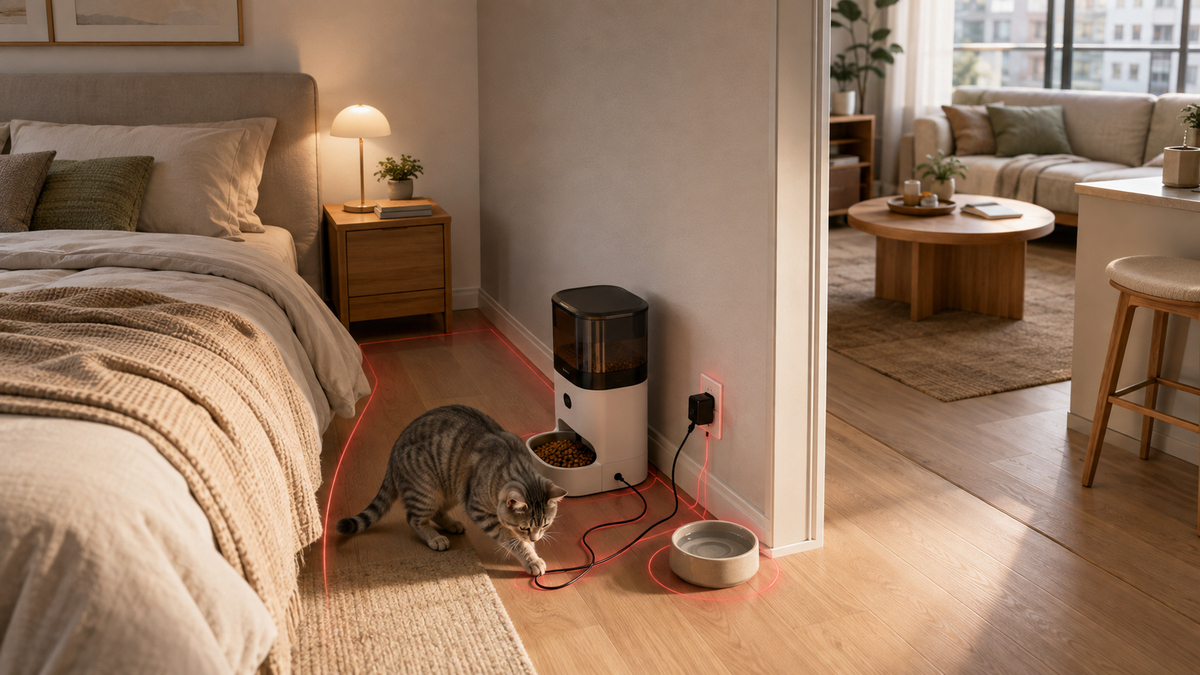
In a one-bedroom or a studio, five constraints compete for one spot, and you usually cannot satisfy all of them. Rank them in this order: safety first, so no cords within reach of a chewing animal and nothing electrical beside standing water; then the shared wall, so a scheduled device is never against a neighbor's bedroom; then your own sleep; then the animal's access; and convenience last. Most placement advice online is one line inside a product review and never mentions the neighbor at all.
Map your walls before you choose a surface
Do this once and it decides everything after.
Walk the perimeter of the apartment and label each wall: shared with another unit, corridor, or internal to your own apartment. In a typical one-bedroom the kitchen and bathroom walls are often internal or back onto services, and at least one bedroom wall is shared with a neighbor.
Then note which shared wall backs their bedroom, if you can work it out from the building's layout. That wall is the one to keep a scheduled device away from, because a cycle that runs at a fixed early hour against a sleeping neighbor is the most avoidable complaint in this whole cluster. Why device noise reaches some neighbors and not others is in the device is the noise: feeders, fountains and boxes through a shared wall.
The outlet problem, and the way around it
The classic studio problem is that the only convenient outlet is beside the bed, which is also the worst acoustic position in the apartment.
Three ways out, in order of preference:
Choose a battery or rechargeable device. This dissolves the constraint entirely, and battery-powered options in this category can run for extended periods between charges. The point here is not which product to buy, it is that the outlet is often a self-imposed constraint and worth checking before rearranging a room around it.
Use a different outlet and route the cord safely. Along a wall, secured, out of an animal's reach, never under a rug where it can be damaged without being seen and never across a doorway.
Move the furniture, not the device. Sometimes the fix is that the bed does not need to be against that wall either.
What a device has to earn to justify a spot in a small apartment at all is covered in which pet devices actually earn apartment space and power.
Safety constraints that outrank everything else
These come before noise, before convenience, and before your own sleep.
Cords and a chewing animal do not share a room. A cord within reach of a dog or cat that chews is a hazard, and no acoustic or convenience benefit outweighs it. Route it out of reach, secure it, or use a device that does not need one.
Water and electricity keep their distance. Fountains and water bowls belong away from power connections and where a spill cannot reach an outlet or a power brick. Put the power connection higher than the water where the layout allows.
Nothing goes where it can be knocked into a walkway. A device bumped off a surface in the night is both a noise event and a hazard.
Keep escape routes clear. An animal that startles during a device cycle needs somewhere to go that is not blocked by the device.
If a placement requires an electrical change rather than a rearrangement, that is a landlord and licensed-electrician question, not a DIY one.
Your sleep, the neighbor's sleep, and the schedule
Once safety and the shared wall are settled, the remaining lever is time rather than position.
A device that runs at 6 a.m. against any wall is a decision you made in an app. If the animal's routine allows a later cycle, that single change often removes the problem for both you and the neighbor, without moving anything. Where the routine does not allow it, the placement has to absorb the whole job, and the mat-under-the-bowl fix in the linked article above does more than moving the device a few feet usually will.
In a studio, where the bedroom is the living room, accept the trade honestly: the quietest available surface is usually the kitchen side, and that is generally also the internal wall, so those two constraints tend to agree.
Placement decides what a failure looks like
The part almost nobody considers until it happens.
Can you see it? A device positioned outside a camera's view is one whose failure you will not notice while away. If you monitor at all, the device belongs in frame.
Can the animal still reach food and water if it fails? A feeder that jams is a welfare problem rather than an inconvenience, and placement affects whether a backup bowl is reachable and whether a jam is recoverable.
What happens to the floor if it leaks or spills? A fountain on carpet in a rental is a different risk from one on tile, and that is a deposit question as well as a hygiene one.
Would a failure alarm reach a neighbor? Devices that beep repeatedly on error exist, and a device against a shared wall alarming all weekend is the scenario worth designing out in advance.
Answer those four before finalizing a spot, and the placement decision is done. For the overall picture of what your neighbors hear from your unit, start at pet noise in an apartment: what neighbors actually hear, and for the impact-noise treatment that applies under any device standing on the floor, see rugs and underlay for pet impact noise.
FAQ
Where should I put an automatic feeder in a small apartment? On a stable, flat surface against an internal rather than a shared wall, away from foot traffic, with no cord within reach of a chewing animal and nothing electrical near standing water. If the only outlet is badly placed, a battery-powered device removes that constraint.
Is it bad to keep a pet device in the bedroom? It is the position most likely to affect your own sleep and, if that wall is shared, your neighbor's. If the bedroom is the only option, timing the cycle away from sleeping hours and putting a dense mat under the bowl matter more than the exact spot.
Can I put a pet fountain on carpet? It is a spill risk in a rental and worth avoiding where possible. If it is unavoidable, use a waterproof tray under it and keep the power connection above the level of any spill.
Does the surface it sits on matter for noise? Yes, and more than the position does for impact noise. A hard surface resting on the floor transmits the impact of food or a mechanism directly into the structure, which is what the unit below hears.
How do I stop my feeder waking the neighbors at 6 a.m.? Change the schedule first, since it is free, then put a dense mat under the bowl, then move it off a shared wall. In that order, because the first one usually solves it on its own.