Cat Zoomies at 4 a.m. and the Neighbor Below You
Your downstairs neighbor is not hearing a cat, they are hearing landings. Map the four spots she jumps down from and treat those, not the whole room.
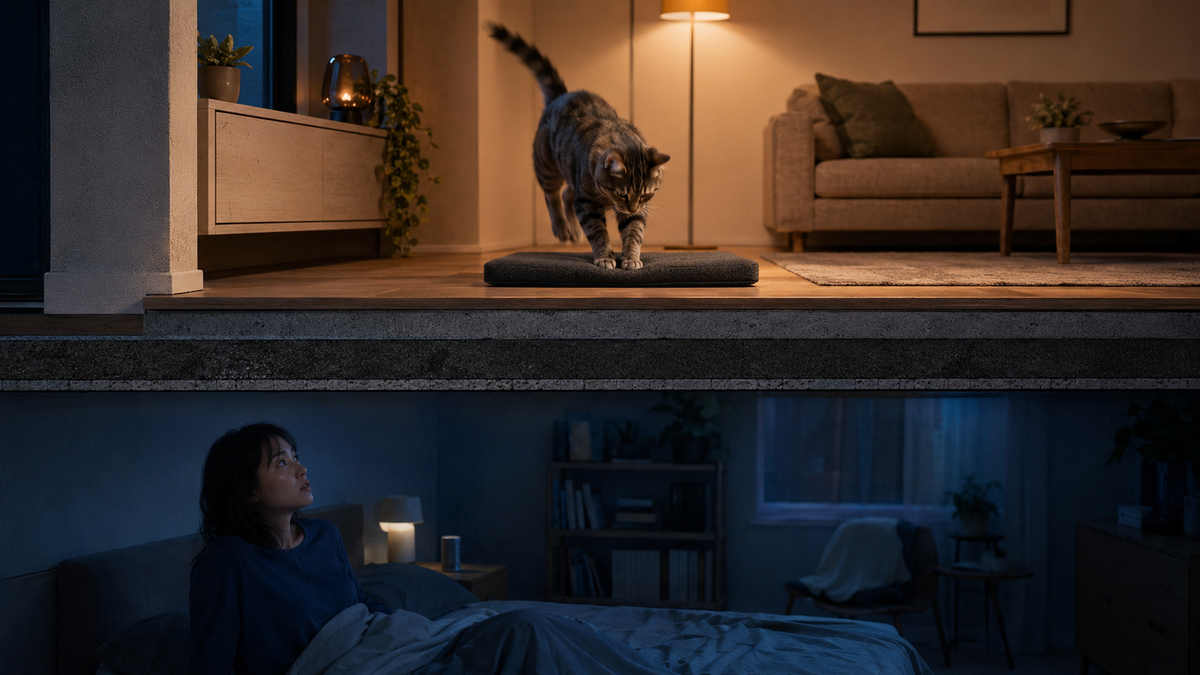
Your downstairs neighbor is not hearing a cat running. They are hearing a small number of landings, each one a concentrated impact into the floor at a specific spot. That is why a large rug in the middle of the living room often changes nothing while four small mats in the right places change a lot. Map the circuit your cat actually runs, treat the landing points, and you address most of what reaches the ceiling below. The behavior itself is normal and largely not something to fix.
What is actually happening at 4 a.m.
Briefly, because this part is well established and it is not the useful half of the answer.
Cats are crepuscular, meaning they are naturally most active around dawn and dusk. The sudden bursts of sprinting are commonly called zoomies, and are described in veterinary-facing sources as frenetic random activity periods, or FRAPs. They typically last a few minutes, often follow a long rest, and are generally a normal expression of energy rather than a sign that something is wrong.
Which means the goal is usually not to stop the behavior. It is to stop the building from transmitting it.
Why the neighbor below hears it and the one beside you does not
A sprint and a landing put energy directly into the floor structure. That is impact noise, and it travels through the joists and the subfloor into the ceiling below, where it is radiated into your neighbor's room. It does not need a gap or a thin wall, and it barely reaches the unit beside you.
A cat's version of this is more concentrated than a dog's. A dog running distributes impacts along a path. A cat jumping down from a counter, a windowsill or the top of a wardrobe delivers a single high-energy strike into one square foot of floor. That is why the complaint is usually described as thumps rather than as running.
The general mechanism is covered in airborne vs impact noise for apartment pets, and the treatment logic in rugs and underlay for pet impact noise.
Map the circuit and treat four spots
Cats are creatures of routine, and the night route is usually the same one every night. Watch it once, or set a camera for a night, and you will typically find between three and six recurring points.
| Typical landing point | Why it is loud | What to put there |
|---|---|---|
| Floor under the bed, on exit | Launch plus landing in one spot | Rug with a dense pad, extending past the bed edge |
| The hallway run | Repeated fast impacts along a line | Runner with a dense pad, full length |
| Floor beneath a kitchen counter | Highest drop in the apartment | Dense mat, larger than it looks like it needs to be |
| Floor beneath a windowsill perch | Frequent, and often at dawn | Mat, or move the perch to a carpeted area |
| Base of a cat tree | Repeated landings all night | Dense pad under the whole footprint |
Two details that decide whether this works. The pad matters more than the rug, because the pad is what absorbs the impact before it reaches the subfloor. And make the covered area bigger than the landing spot, since a cat that lands half on and half off a mat gets you half the benefit.
Four well-placed treated spots usually outperform one large rug, and cost less.
What the timing advice is worth
The standard advice is to play with the cat vigorously during the day and again before bed, on the reasoning that a cat which has rested all day has energy to spend at four in the morning. General guidance in this area suggests a focused play session before bedtime can reduce night activity.
Two honest caveats. It is general guidance rather than a guaranteed result, and it varies enormously between individual cats. And it asks you to change an animal's behavior in order to solve a building's acoustic problem, which is a longer and less reliable route than treating the floor.
So do it if it suits your household, and do not promise a neighbor a result on the strength of it. The floor treatment is the part you control.
Feeding, play routines and indoor-cat enrichment as a subject in their own right are outside what this site covers. This page covers the floor, the landings and the neighbor.
When 4 a.m. activity is a question for a veterinarian
Normal night activity is normal. Some changes are not, and they are worth raising rather than managing at home.
Specifically: a sudden change in an older cat's night-time activity or vocalizing, activity that is new rather than long-standing, or night activity that arrives alongside changes in appetite, drinking, weight, litter box use, or how the cat moves.
None of that is a diagnosis and nothing here identifies a cause. It is the set of things worth mentioning to a veterinarian, who can examine the animal and rule things out, which is not something an owner or an article can do. If you are unsure whether what you are seeing counts as a change, that uncertainty is itself a reason to ask. Who to approach, and what each professional can actually do, is set out in when the answer isn't a device: getting a trainer or a vet involved.
Talking to the downstairs neighbor about a cat
One thing is specific to cats here and worth using.
People underestimate cats as a noise source, so a downstairs neighbor may have concluded that someone is moving furniture, or that there is a dog, or that a child is up. Simply telling them it is a cat, and that you are treating the floor, resolves a surprising amount of the friction on its own, because it replaces an unexplained noise with an explained one.
Then do what you would do for any pet noise: ask which times are worst and which room they hear it in, treat those spots first, and go back a week later. The approach is in talking to the neighbor before it becomes a complaint, and if it has already become formal, the response structure is in documenting a noise complaint when it's your pet.
For where this fits in the whole picture of pet noise in a building, start at pet noise in an apartment: what neighbors actually hear.
FAQ
Why does my cat run around the apartment at 4 a.m.? Cats are crepuscular and most active around dawn and dusk, and the sudden bursts are commonly called zoomies, described as frenetic random activity periods. They usually last a few minutes and are generally normal, particularly after a long daytime rest.
Will a rug stop my downstairs neighbor hearing my cat? A rug with a dense pad reduces it, and placement decides how much. Cat noise is concentrated at landing points rather than spread across the floor, so covering the spots she jumps down onto matters more than the total area covered.
Should I stop my cat from doing zoomies? It is normal behavior and generally not something to suppress. The practical target is the floor rather than the cat, with daytime and pre-bed play as an optional extra that helps some cats and not others.
Do interlocking foam tiles work for this? They help at the point of impact and they are renter-friendly, though they are light and compress easily, so treat them as a landing-zone treatment rather than as a whole-floor acoustic solution.
When should I talk to a vet about night activity? When it is a change rather than a long-standing pattern, especially in an older cat, or when it comes with changes in appetite, drinking, litter box use or movement. A veterinarian can examine the cat and investigate; an article cannot.